Repetition
Has the player or team already received a clear warning for the same behaviour?
Umpire guide · checked 2 October 2026
Use the lightest penalty that restores control—and escalate when conduct, repetition or danger demands it.
Under the FIH Rules, an umpire may caution a player verbally, suspend them for two playing minutes with a green card, suspend them for at least five playing minutes with a yellow card, or exclude them for the rest of the match with a red card. National guidance can recommend longer suspensions for particular conduct.
| Action | Duration | Meaning |
|---|---|---|
| Verbal caution | No fixed time | A clear, credible warning when formal suspension is not yet needed. |
| Green card | 2 playing minutes | Temporary suspension; the team plays with one fewer player. |
| Yellow card | At least 5 playing minutes | Temporary suspension. Duration reflects the seriousness of the offence. |
| Red card | Rest of the match | Permanent exclusion; the team continues with one fewer player. |
The Rules do not turn every incident into a fixed card colour. Consider the whole action:
Has the player or team already received a clear warning for the same behaviour?
Was the action deliberate, cynical or designed to break down play?
Did it remove an opponent’s genuine opportunity or damage match control?
Was there force, a vulnerable opponent, going to ground or a need for evasive action?
Was there dissent, abuse, intimidation or an accusation of bias or cheating?
Consistency means comparable incidents receive comparable consequences. It does not mean every foul receives the same card regardless of context.
These examples show how the same FIH card framework is made more specific nationally. They apply only where the cited national guidance governs the match.
A physical offence with no regard for an opponent’s safety—for example a sliding tackle—is at least a 10-minute yellow card under the KNHB 2026–27 Standard Agreements. An intentional offence against an opponent away from the ball is at least yellow for 5 or 10 minutes.
Crowding must be penalised with green. A dismissive gesture, cynical applause, pointed head-shaking, running in from distance to protest or forceful protest must receive a personal penalty: green is the starting point, with yellow available when the behaviour is more severe.
England Hockey’s September 2026 guidance uses green for low-impact dissent; yellow 5 for strong dissent, intentional offending or physicality/danger; and yellow 10 for high-impact deliberate, physical or dangerous conduct, including going to ground and making an opponent fall or take evasive action.
England places threatened or actual violence, abuse involving foul language or protected characteristics, and direct accusations of bias or cheating in its red-card category. DHB guidance requires red for violence or an extremely serious insult to the umpire.
A defender who carelessly throws penalty-corner protective equipment and strikes a person at or above the knee must receive yellow. Deliberately throwing it at someone can justify a more serious sanction, including red.
“High risk, high penalty” appears in older international briefing material as a way to describe risky physical challenges. It is a useful principle, not an automatic card rule: judge whether an offence occurred, then assess intent, impact, physicality and danger under the current rules and competition guidance.
The 2026–27 standard agreements prescribe or recommend specific 5- or 10-minute yellow cards for certain deliberate, physical or dangerous offences. Two greens lead to a 5-minute yellow; two yellows lead to red in Dutch competition administration.
September 2026 guidance uses an impact-based ladder: green for lower-impact conduct, yellow 5 or 10 for more serious, deliberate, physical or dangerous conduct, and red for violence, abuse or a second yellow in defined circumstances.
The Rules state two minutes for green, at least five for yellow and the rest of the match for red. Tournament regulations and umpire briefings may add administration details.
This comparison shows why a procedure learned in one competition must not automatically be used in another. It is a practical overview of the cited rules, not a substitute for the current competition regulations.
| Country or competition | Captain and team-official treatment |
|---|---|
| FIH international tournaments | Rule 3.4 allows a personal penalty when a captain fails to manage player behaviour or correct substitutions. The general card table is written for players. At major FIH tournaments, the Team Manager is responsible for the bench; a Technical Official may remove a person after a warning and the Technical Delegate may impose a suspension. Loud coaching from a video tower or elsewhere outside the bench is prohibited. |
| Netherlands · KNHB | The captain’s responsibility also covers team officials. Dutch competition uses a separate captain-card role and an explicit verbal–green–yellow–red framework for team officials. Conduct by team staff behind the fence or on a video tower can be managed through the captain. |
| Belgium · RBHA | The published 2025–26 national regulations distinguish a yellow captain card when combining cards and allow yellow or red to be shown directly to a non-playing person on the bench. The team plays one player short for 5 minutes after yellow or 10 minutes after red; the red-carded person must leave the venue. |
| France · FFH | The 2026–27 competition regulations allow registered players and team staff on the bench to receive yellow or red cards. If a person on the bench is sanctioned, a player is withdrawn so the team plays short; accumulated cards can also lead to later suspension. |
| England · England Hockey | A red card may be issued directly to a team official, including a manager, coach, physiotherapist or doctor, even if that person is not on the team sheet. The person must leave the pitch surroundings and may not continue coaching. The cited national page does not establish a general green–yellow ladder for team officials. |
| Australia · Hockey Australia | Hockey Australia uses the FIH Rules as its national baseline and warns that local, regional and state competition regulations may differ. No single national KNHB-style card ladder for coaches is stated on its public Rules of Hockey page. |
| United States · NFHL example | This league policy, adapted from NCAA rules, permits green as a warning and red as an ejection for a coach or bench personnel; yellow is not used for coaches. The head coach is responsible for bench conduct. This is a competition example, not a universal USA Field Hockey rule. |
HockeyUmpire
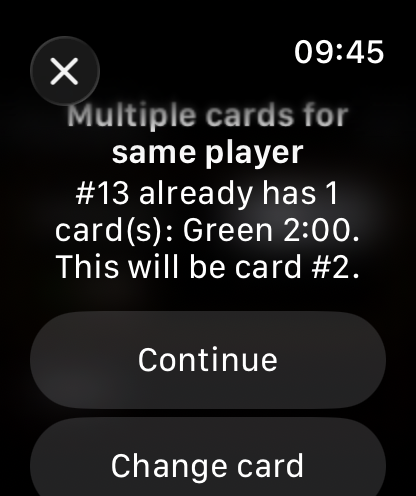
HockeyUmpire keeps temporary suspensions visible alongside match time and score on iPhone and Apple Watch. Different alerts help distinguish the end of a card from the end of a period.
The app records your decision; it does not choose the card or duration for you.
Try card timers free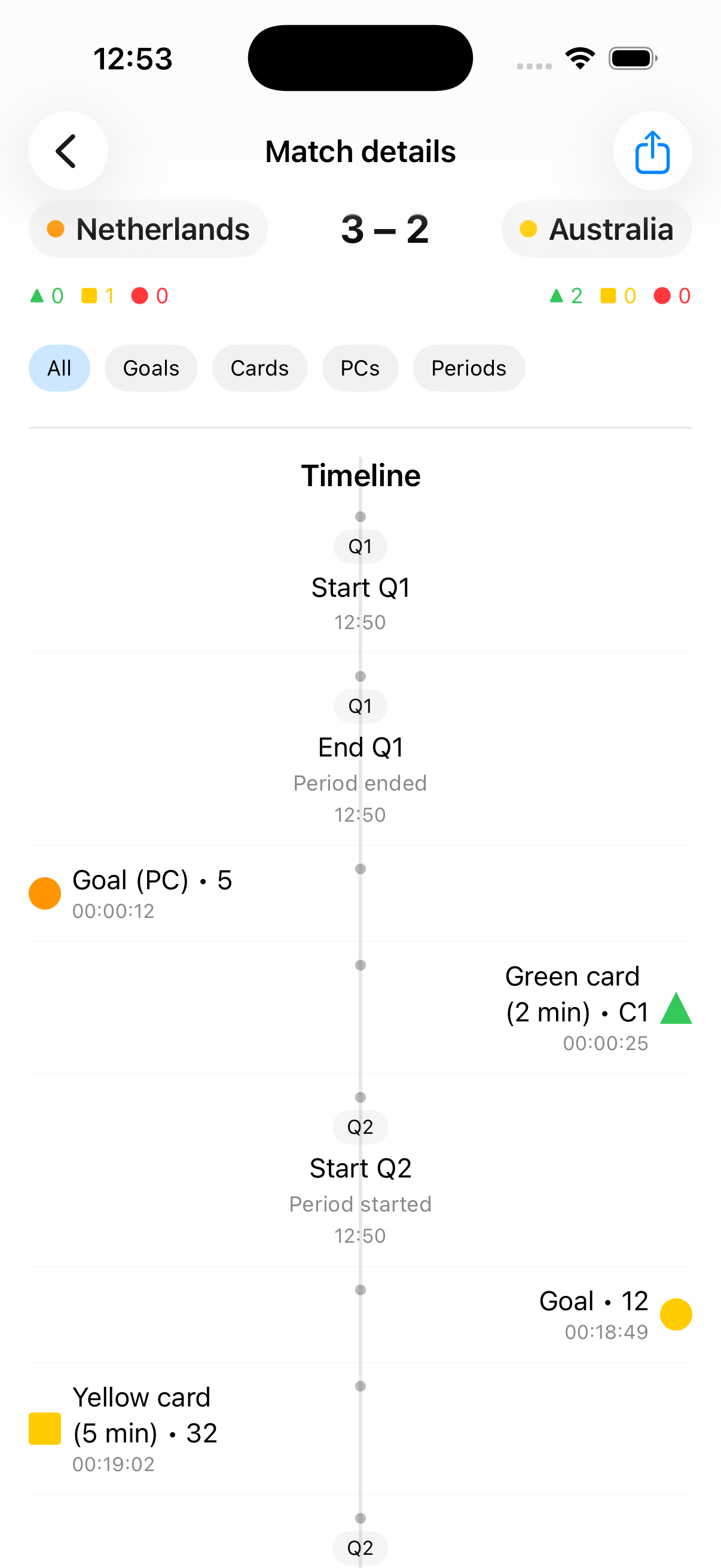
Checked on 2 October 2026. Local regulations remain decisive.
A green card is a two-playing-minute temporary suspension under the FIH Rules.
A yellow card is at least five playing minutes under the FIH Rules. National guidance or competition regulations may prescribe or recommend a longer duration for certain conduct.
Yes. The team plays with one fewer player during a green or yellow suspension and for the rest of the match after a red card.
FIH guidance allows two yellow cards for different offences, with the second suspension significantly longer. Repetition of the same carded offence should be escalated. Local competition administration can be more specific.
An aanvoerderskaart is not a separate card colour. It is a personal penalty shown to the captain for failing a captain’s responsibility, such as managing team conduct or correct substitutions. KNHB guidance assesses a card received as captain separately from a card received as a player.
Under KNHB agreements, team officials outside the fence or on a video tower remain under the captain’s responsibility. The captain is addressed and can be penalised if the conduct continues.
No. FIH Rule 3.4 provides the international basis for a personal penalty when a captain fails their responsibilities, but national associations and competitions decide how coaches, team officials and off-field conduct are sanctioned. Always check the regulations for the match.
No. Under the current Dutch guidance, the minimum 10-minute yellow applies to a physical offence committed with no regard for an opponent’s safety, with a sliding tackle given as an example. First decide whether the action is an offence, then assess its physicality and danger.
Not every word automatically produces the same card under every competition. Serious intentional misconduct can require a direct red under FIH guidance, while national guidance gives more specific examples. Judge the words, target, context, threat and severity, and record the exact language used when reporting a red card.